
Your domestic eCommerce store has no physical boundaries. Stop limiting your shipping to domestic borders.
D2C founders often hesitate to export because cross-border logistics feels like a complex maze. You worry about customs clearance delays, unexpected tax duties, and packaging guidelines. Staying domestic feels safe.
But domestic markets are highly saturated. Global markets represent a massive growth channel. Selling to international buyers increases your average order value and protects your margins.
Procurement costs in India remain low. Selling in foreign currencies shields your business from local seasonal slumps. With a structured cross-border strategy, international shipping is as straightforward as domestic courier services.
Understand the regulations. Automate your documentation. Scale your brand internationally.
India’s cross-border e-commerce exports are projected to touch $200 billion to $300 billion by 2030 (DGFT, 2026). D2C brands using multi-carrier shipping engines like ShipLive access negotiated global rates, calculate duties upfront, and automate customs compliance, cutting international logistics costs by 20% to 40%.
India’s merchandise export target is set at $1 trillion by 2030, with e-commerce exports driving up to $300 billion of that volume, according to the Directorate General of Foreign Trade (DGFT) (DGFT, 2026).
Step 1 – You must establish a firm legal foundation before booking your first global shipment. Skip this step and customs officials will impound your packages at the port of departure.
Step 2 – Get your company registered. Choose a sole proprietorship, limited liability partnership, or private limited entity.
Step 3 – Obtain your Import Export Code (IEC). The IEC is a unique ten-digit identification number issued by the DGFT. It is legally mandatory for all commercial exports from India. You can apply for it online on the DGFT portal.
Step 4 – Link your bank account to an Authorized Dealer (AD) Code. Your bank issues this unique fourteen-digit code on their official letterhead. You must register this AD Code at the specific customs port where your courier partner processes international shipments. For instance, if your packages leave India from Delhi Air Cargo, register the AD Code at Delhi Customs.
Step 5 – Customs clearance requires the registered AD Code to track inward remittances of foreign exchange. Do not skip this registration. Failing to link inward foreign funds to a specific shipping bill within the RBI-mandated timeline leads to FEMA non-compliance flags.
Step 6 – Register with a relevant Export Promotion Council (EPC) to obtain a Registration Cum Membership Certificate (RCMC). D2C brands selling jewelry need registration with the Gem and Jewellery Export Promotion Council (GJEPC). Apparel brands must register with the Apparel Export Promotion Council (AEPC). Handicraft brands should register with the Export Promotion Council for Handicrafts (EPCH).
This registration gives you access to export incentives, market development assistance, and duty drawback benefits under national schemes. RCMC certificate registration is necessary to claim duty-free raw material imports, safeguarding your manufacturing margins.
No more regulatory surprises. No more port delays. Establish your compliance before you launch.
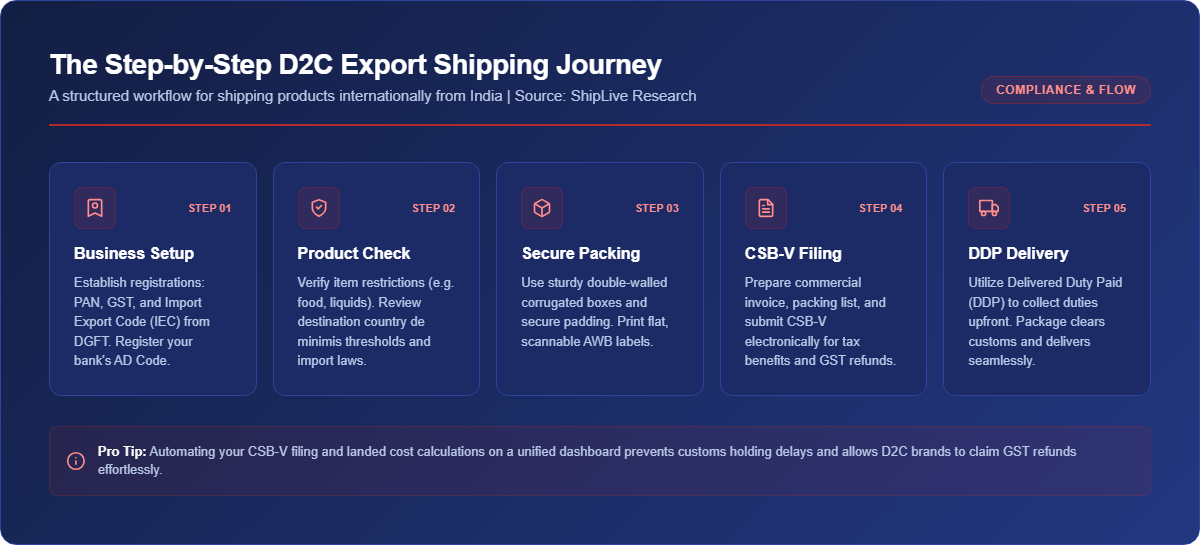
Optimizing your international fulfillment process cuts customs clearance times by 40% (Statista, 2026). A structured workflow ensures your packages reach customers without transit exceptions or damage. Follow this five-step process to manage your export logistics efficiently.
Verify that your items are not prohibited. Different countries enforce distinct import bans.
The United States restricts certain agricultural items. The European Union bans specific cosmetics ingredients. The Middle East maintains strict guidelines for food items. Review destination country import guidelines. Ensure your product category is clear.
Protect your goods. International shipments travel thousands of miles, passing through multiple automated sorting hubs.
Stop using standard domestic single-wall cardboard boxes. Use double-wall or triple-wall corrugated boxes.
Fill empty spaces with air cushions or bubble wrap. Protect fragile items from vibration during transit.
Seal all edges with heavy-duty packaging tape. Create a weather-resistant outer layer to protect against moisture.
Print your shipping label clearly. Attach the label flat on the largest surface of the package.
Do not place tape over the barcode. Barcode scanners need a clean, flat surface to read the tracking details. Attach your customs documents in a clear pouch on the side of the box.
Choose your courier route based on destination. No single carrier is the cheapest or fastest for every country.
Use express carriers for time-sensitive luxury shipments. Use economy postal services for lightweight, low-value accessory items. Compare rates in real time before printing shipping labels.
Monitor your shipment’s progress. Use automated tracking links to keep your customers informed. Provide real-time updates when the package departs India, clears destination customs, and arrives for local delivery.
Incomplete documentation causes over 70% of export shipment delays, according to the Ministry of Commerce (Ministry of Commerce, 2026). You must prepare accurate paperwork to ensure smooth customs clearance at both departure and arrival ports.
Get every document ready before booking your pickup.
Prepare a detailed commercial invoice. The invoice is the primary document customs officials use to evaluate duties.
List the sender and recipient details. Include complete contact numbers and email addresses.
Provide a detailed description of each item. Avoid generic descriptions like “gift” or “clothing.”
Specify “100% Cotton Knitted Men’s T-shirt” instead of “Apparel.”
Declare the correct unit value and transaction currency.
Specify the eight-digit HS (Harmonized System) Code for each product item. The HS Code classifies products globally for customs tariff and tax assessment. Getting this code wrong by a single digit causes custom authorities to misclassify your goods, resulting in shipment delays, incorrect tax assessments, and import penalties.
Define the clear terms of trade, known as Incoterms, such as DDP or DDU. State the country of origin of the manufactured goods clearly.
Generate a packing list. This document details the contents of each box in the shipment.
Specify the net weight and gross weight of each box. Include the exact dimensions of the packaging. Ensure the information matches the commercial invoice.
File the appropriate shipping bill. For commercial e-commerce exports via courier, file under the Commercial Shipping Bill V (CSB-V) format.
Avoid CSB-IV filing for commercial sales. CSB-IV is reserved for non-commercial gifts and documents. The CSB-V links the shipment to your IEC and bank AD Code. It provides legal proof of export.
Provide your company KYC documents. Keep your IEC copy, GST certificate, and AD Code letter updated on your shipping panel.
Your courier partner submits these files digitally to the ICEGATE customs portal. Protect your business from customs penalties. Keep your documentation precise.
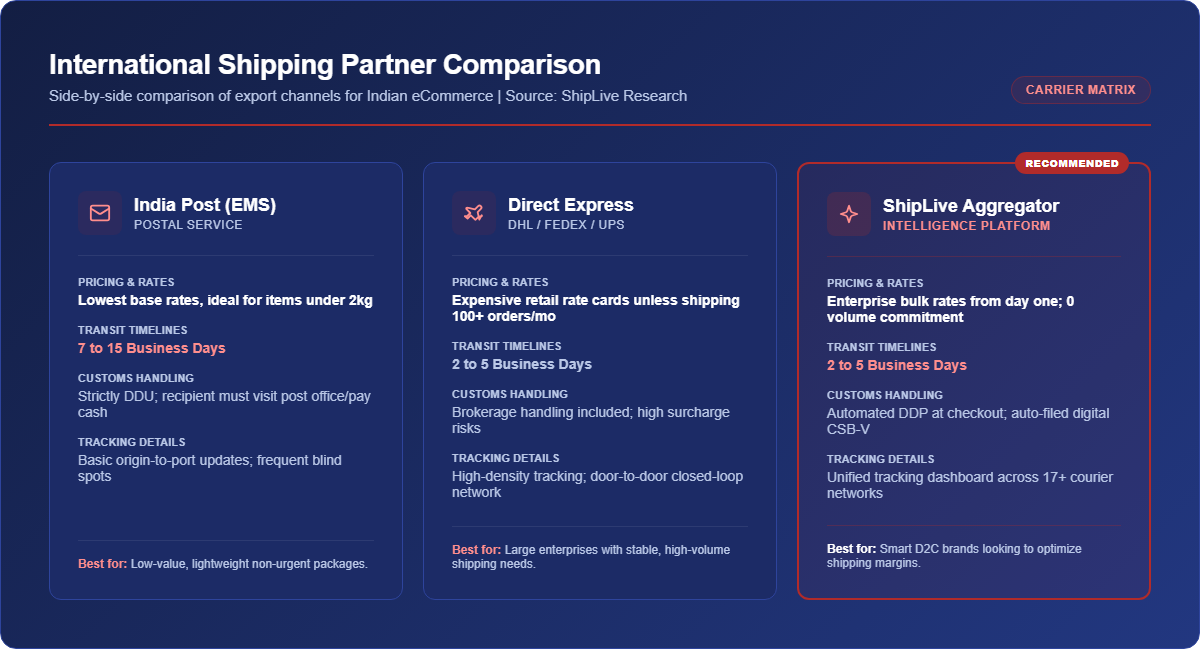
Exporters using multi-carrier aggregators save between 20% and 40% on international courier costs (DGFT, 2026). Choosing the right shipping partner model determines your export profit margins. Compare the differences between direct carrier accounts and technology-driven aggregators.
The Direct Carrier Limitation
Direct express carriers demand minimum monthly shipping volumes. If you do not meet their volume thresholds, they place your business on retail rate cards.
These retail rates are prohibitively expensive for growing D2C brands. Direct carriers also charge significant surcharges. Fuel adjustments, remote area delivery fees, and address correction charges inflate your final invoice.
You must manage separate dashboards for DHL, FedEx, and Aramex. Integrating multiple APIs into your Shopify store requires engineering hours.
The Aggregator Advantage
Aggregators consolidate volumes from thousands of D2C merchants. They negotiate bulk rate discounts with premium carriers, passing the savings to your business.
You access enterprise-grade shipping rates with zero volume commitments.
Manage all global shipments from one window. Compare real-time rates across DHL, FedEx, Delhivery, and Aramex. Dynamic routing algorithms choose the best carrier for each order automatically.
ShipLive functions as an intelligence-driven multi-carrier shipping aggregator. Our international shipping platform simplifies cross-border logistics for Indian brands.
Access our automated Weight Dispute Portal. Upload your packaging images to challenge incorrect carrier weight audits.
Flag high-risk orders using our AI-driven RTO Shield. Secure rapid cash flow with our T+2 COD remittance cycle.
Get dedicated support from human account managers. We do not use automated bot loops. You focus on product design and global marketing. We handle the logistics backend.
Our shipping engine calculates these taxes in real time based on cart contents and HS codes.
Integrate our engine with your store. Showcase the final, landed price at checkout.
Protect your global conversion rates. Improve your customer experience. Stop losing international sales to surprise fees. Request a demo to set up landed cost calculations for your e-commerce store today.
Exporters using CSB-IV instead of CSB-V lose up to 18% of their margins by missing GST refunds (DGFT, 2026). Filing the correct shipping bill is a financial strategy, not just a compliance step. Understand the difference between the two filing types.
The CSB-IV Risk
Many small exporters use CSB-IV filing. They declare commercial orders as gifts or samples to avoid paperwork. This practice is illegal for commercial e-commerce sales.
Filing under CSB-IV blocks you from claiming export incentives. You cannot claim input tax credit refunds on raw materials. This restriction represents a direct hit to your manufacturing margins.
The CSB-V Benefit
Filing under CSB-V is the correct method for commercial courier exports up to ₹10 lakh per shipment. It generates an official shipping bill number linked to your Import Export Code.
Use this official proof of export to claim GST refunds on your raw materials. Your bank registers the inward foreign remittance from international buyers against the specific shipping bill number on the ICEGATE portal. This process ensures regulatory compliance and makes it easy to close bank shipping bills, avoiding bank penalty fees.
You can claim duty drawbacks and benefits under the Remission of Duties and Taxes on Exported Products (RoDTEP) scheme. The government refunds a fixed percentage of the FOB value of your exports under this scheme. These incentives recover a percentage of the embedded taxes paid during manufacturing, directly protecting your bottom line.
Automate Your Compliance
Manual CSB-V filing requires coordination with customs brokers. You must submit documents manually for each package.
Use ShipLive to automate this process. Our platform generates the electronic CSB-V manifest based on your order details. We submit the data directly to the customs department. You print compliant shipping labels instantly from your dashboard.
Protect your margins. Keep your compliance automated. Explore our international shipping features to start saving.
What is the cheapest way to ship products internationally from India?
EMS Speed Post is the cheapest option for lightweight parcels under 2kg, taking 7 to 15 days. For active D2C brands, utilizing ShipLive’s international shipping platform offers discounted rates with premium carriers like DHL and FedEx, delivering faster with end-to-end tracking.
Do I need an IEC code to ship commercial products internationally?
Yes, an Import Export Code (IEC) issued by the DGFT is legally mandatory for all commercial e-commerce shipments from India. Custom departments will reject commercial shipments that do not have an active IEC linked to the shipping bill.
What is the difference between DDU and DDP shipping?
Delivered Duty Unpaid (DDU) requires the recipient to pay customs duties before delivery, causing high rejection rates. Delivered Duty Paid (DDP) collects duties at checkout, paying them upfront to ensure smooth customs clearance and a seamless doorstep experience.
What documents are required for CSB-V e-commerce exports?
You need a commercial invoice with HS codes, a packing list detailing package weight and dimensions, your Import Export Code copy, and a registered bank Authorized Dealer (AD) Code to file a CSB-V shipping bill.
How long does international express courier delivery take?
Premium international express services like DHL and FedEx deliver to major global markets (US, UK, Middle East) in 2 to 5 business days. Budget economy or surface shipping options take between 7 to 15 business days depending on customs queues.






E: ecommerce@aipexworldwide.com
M: +91 90225 55616
A: 302, Twin Complex, Phase 1, Near Marol Naka Aqua Line, Andheri East, Mumbai - 400 059, Maharashtra, India.