
Your eCommerce store does not have borders. Why should your shipping?
eCommerce and D2C founders often hesitate to export because cross-border logistics feels like a black box. You face erratic transit times, unexpected custom duties, and complex documentation. It is easier to stay domestic.
But domestic markets are crowded. Global markets are waiting. Selling to international buyers is the fastest way to increase average order value and protect your bottom line.
With the right cross-border strategy, international shipping is as simple as domestic shipping.
Here is what you need to know to pick the best international courier partner for your online store, protect your margins, and avoid shipping delays.
TL;DR: India’s cross-border e-commerce exports are projected to touch $200 billion to $300 billion by 2030 (DGFT, 2026). Growing D2C brands use multi-carrier shipping engines like ShipLive to access negotiated global rates, calculate duties upfront, and automate customs compliance, cutting international logistics costs by 20% to 40% (DGFT, 2026).
India’s merchandise export target is set at $1 trillion by 2030, with e-commerce exports driving up to $300 billion of that volume (DGFT, 2026). For D2C founders, going global unlocks higher purchasing power, insulated profit margins, and diversified revenue channels that shield your business from domestic seasonality.
D2C brands in India have a structural advantage. Your procurement costs are in Rupees, but your international sale price is in Dollars or Dirhams. This arbitrage window protects your margins on every unit sold. A fashion apparel piece selling for ₹999 in India can easily command $45 (approx. ₹3,700) in the United States.
The regulatory environment has also eased. In early 2026, the government removed value-based restrictions on courier exports (DGFT, 2026). You no longer need cargo-specific logistics for high-value shipments under ₹10 lakh. You can export directly using standard courier channels.
But to win globally, you must solve the delivery experience. International customers expect the same level of service they get from local brands. If a customer in London experiences customs clearance delays or gets hit with unexpected import duties at their doorstep, they will reject the delivery. You pay the double shipping cost loop.
Global consumers are actively seeking authentic Indian products. Whether it is premium organic cotton apparel, artisanal home decor, or Ayurveda-based cosmetics, the demand in North America and Europe is scaling rapidly (Statista, 2026). In fact, search interest for “made in India” organic brands has risen by 35% in major western cities (Statista, 2026). D2C brands that position their products as high-value, direct-to-consumer items easily command 3x to 4x higher pricing in global markets compared to their domestic average order value.
Logistics is no longer a simple delivery function – it is a financial strategy. Let’s look at the courier partners that can help you execute this strategy.
Global express integrators handle over 75% of time-sensitive D2C shipments, but smart exporters combine these carriers to optimize regional delivery costs (Statista, 2026). No single international courier service dominates every shipping lane, meaning your business must route orders dynamically based on cost and destination.
Here is the breakdown of the top international courier partners:
DHL Express is the global gold standard for premium express shipping. If your brand sells high-value items — like jewelry, premium handicraft, or luxury apparel — DHL’s reliability and tracking density are hard to match. They operate a dedicated air fleet that connects India to 220+ countries. DHL’s closed-loop network means the same company handles your package from pickup in Mumbai to doorstep delivery in New York, reducing package transit exceptions to under 1% (Statista, 2026).
Best For: Speed, high-value goods, premium tracking.
Strength: Door-to-door delivery within 2-4 days, comprehensive customs clearance brokerage.
What to Watch Out For: High base shipping rates and additional peak-season surcharges.
FedEx offers exceptional depth in the North American corridor. If the United States is your primary target market, FedEx provides reliable delivery dates and automated custom clearance documentation. Their cross-border services are built to handle high e-commerce volumes efficiently.
Best For: Shipping to the US, commercial cargo integration.
Strength: Strong broker-inclusive customs clearance, competitive mid-weight shipping rates.
What to Watch Out For: Slower delivery timelines on economy shipping options.
Aramex dominates shipping to the Middle East and GCC countries. With a massive local distribution network in the UAE, Saudi Arabia, and Egypt, Aramex provides local cash-on-delivery (COD) options and localized customs handling that western integrators cannot replicate. Aramex has established deep regional integration in the Middle East, making them indispensable if your primary customer base resides in Dubai, Riyadh, or Cairo. They manage their own customs warehouses in these hubs, reducing clearance delays to under 12 hours (DGFT, 2026).
Best For: Middle East and GCC region shipments.
Strength: Lower cost for GCC zones, strong in-house customs clearance in Dubai.
What to Watch Out For: Limited speed and network depth in North America and Europe.
Delhivery has expanded its domestic tech stack to cross-border shipping, partnering with global players to offer budget-friendly international shipping for Indian MSMEs. They cover major export lanes including the UK, EU, and UAE. By integrating their domestic sorting hubs directly with international gateways, they minimize origin-side handling delays for Indian exporters (DGFT, 2026).
Best For: Cost-conscious D2C brands, low-weight parcels.
Strength: Seamless integration with domestic warehouse networks, economical international surface options.
What to Watch Out For: Inconsistent transit times in remote international zones.
DTDC and Blue Dart utilize global partnerships (including Blue Dart’s alignment with DHL) to offer international forwarding services. They are highly reliable if you want to consolidate international packages from multiple domestic hubs.
Best For: Regional consolidation, standard express shipping.
Strength: Large domestic footprint makes package pickup effortless across India.
What to Watch Out For: Customs documentation requires manual intervention on standard accounts.
India Post is the most economical way to ship lightweight items internationally. If your brand deals in low-cost accessories or books where shipping cost determines purchase viability, EMS Speed Post is the only option that keeps unit economics positive.
Best For: Micro-shipments, budget-friendly economy shipping.
Strength: Lowest shipping rates for small packages, reaching remote post offices worldwide.
What to Watch Out For: Long transit times (7-15 days), basic tracking updates, and zero door-to-door customs assistance.
ShipLive takes a different approach. We didn’t just build another international shipping service; we built a platform that connects your store with 17+ carrier partners — including DHL, FedEx, Aramex, and Delhivery — through a unified international shipping dashboard. You manage your global shipments from one window.
Best For: Scaled D2C brands wanting multi-carrier flexibility, automated customs compliance, and cost optimization.
Strength: Automated Landed Cost calculations, instant rate comparison across carriers, automated CSB-V filing, and dedicated human managers with a zero-bot support policy.
What to Watch Out For: Needs an active export code (IEC) to unlock full automation features.
Important Customer Insight
Most D2C brands make the mistake of using a single direct carrier for all global shipments. They pay premium DHL rates for a package going to Dubai, where Aramex would be 40% cheaper and just as fast. Or they ship an urgent order to New York via Delhivery, risking customs delays. Using an aggregator allows you to route each order dynamically.
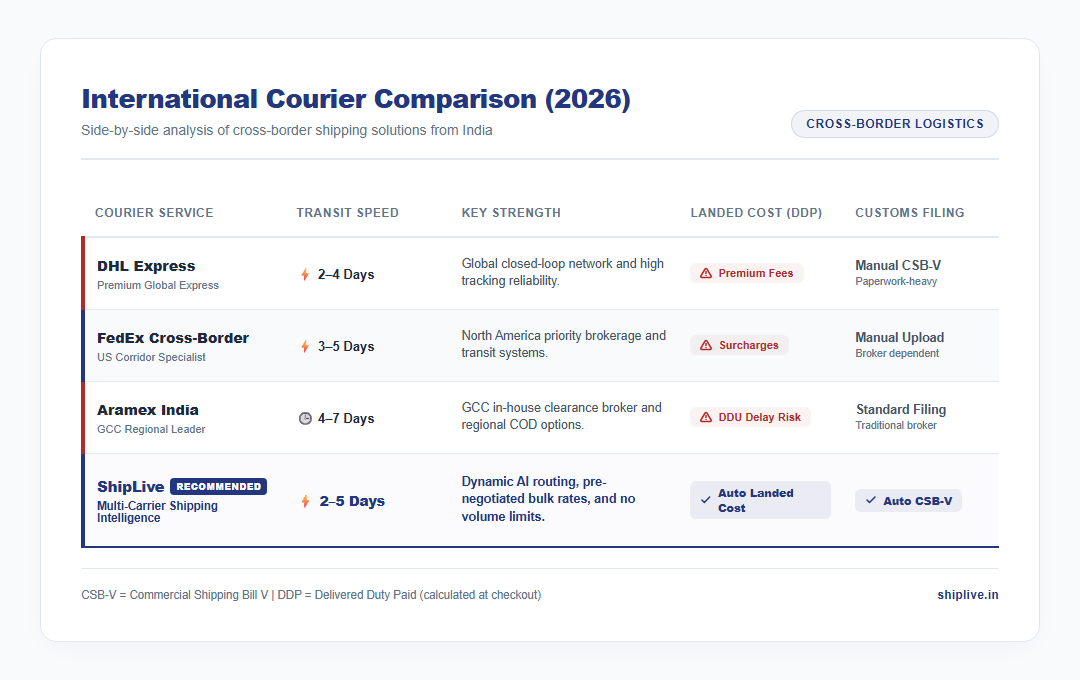
D2C brands using multi-carrier aggregators save 20% to 40% on international shipping costs compared to single-carrier accounts (DGFT, 2026). While direct contracts with DHL or FedEx suit large enterprises with guaranteed daily volumes, aggregators remove barriers for growing brands by offering discounted rates without volume commitments.
Direct carriers demand minimum shipping guarantees. If you do not ship 100 packages a month, they place you on their highest retail rate card. This makes international expansion prohibitively expensive for early-stage brands. In addition, direct carriers charge high surcharge fees for remote address deliveries, remote area pickups, and fuel adjustments that can increase your final shipping invoice by up to 25% (DGFT, 2026).
Shipping aggregators consolidate volumes from thousands of D2C sellers. They negotiate bulk rate discounts with FedEx, Aramex, and DHL, passing those savings directly to you. You get enterprise-grade shipping rates from day one. By routing through an aggregator, D2C brands can access multiple networks without having to maintain separate minimum volumes for each carrier.
There is also the technology barrier. If you ship directly, you must integrate separate APIs for DHL, FedEx, and Aramex into your Shopify or WooCommerce store. You manage multiple dashboards, tracking pages, and monthly invoices.
An aggregator gives you one API, one tracking page, and one invoice. You compare real-time shipping rates across carriers before dispatching. If FedEx is experiencing delays in Europe, you switch to DHL with a single click on your dashboard. You can access these platform features or check out our developer integrations to manage all shipments from a single dashboard.
At ShipLive
You manage your business. We manage the logistics complexity.
Over 55% of international shoppers abandon their online shopping carts due to unexpected customs duties, taxes, or shipping fees at checkout. Providing full landed cost transparency is essential to build trust, boost global conversion rates, and prevent delivery rejections at the customer’s doorstep.
There are two ways to handle international shipping duties:
DDU (Delivered Duty Unpaid):
You ship the package without paying duties. The customer receives a notification from customs demanding payment before delivery. This leads to delivery delays, customer anger, and high shipment rejection rates.
DDP (Delivered Duty Paid):
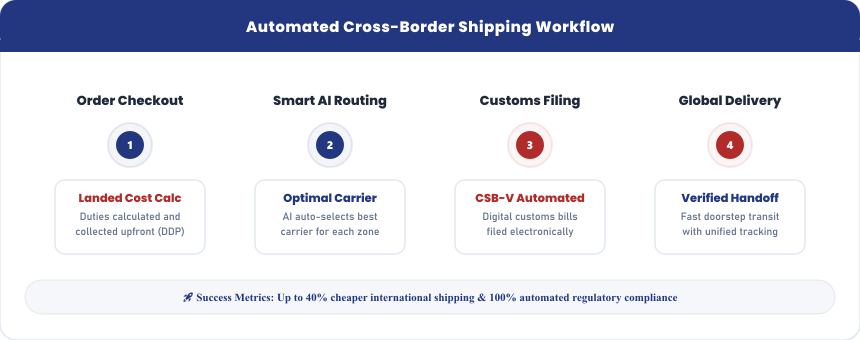
You calculate duties at checkout, collect them from the customer, and pay the courier upfront. The package clears customs automatically. The customer gets a seamless doorstep delivery experience.
Smart D2C founders choose DDP. It protects your brand reputation.
But calculating customs duties manually for 180+ countries is impossible. Every country has different tax thresholds (de minimis values) and product categories. For example, the US has an $800 de minimis threshold where duties are zero, while the EU charges VAT on every import regardless of value.
A shipping aggregator like ShipLive calculates these taxes in real-time at checkout based on the customer’s cart. The buyer sees the exact, final price. No surprises. No delivery friction.
Filing a Commercial Shipping Bill V (CSB-V) allows Indian D2C exporters to claim duty drawbacks, GST refunds, and tax benefits under the RoDTEP scheme. Automating this document generation ensures your business remains fully compliant with cross-border trade regulations without adding operational overhead.
Many small D2C brands ship goods under CSB-IV (document shipping/gift mode) to avoid paperwork. This is illegal for commercial sales. It also blocks you from claiming tax benefits. Exporters using CSB-IV are ineligible to claim GST input tax credit on raw materials, representing a direct 18% hit to manufacturing margins.
Filing under CSB-V is the correct way to export. It gives you an official proof of export. Your chartered accountant can use this proof to claim GST refunds on inputs, protecting your bottom line. Under CSB-V, every shipment is assigned a unique Shipping Bill number linked to your Import Export Code.
But manual CSB-V filing requires coordinate work with customs brokers. You must submit the shipping bill, commercial invoice, packing list, and exporter declaration.
Shipping aggregators like ShipLive automate this entire process. Our platform generates the CSB-V document based on your order details. The document is submitted electronically to the customs portal. You get your shipping labels and tracking number instantly.
You protect your margins. We protect your compliance.
What is the cheapest international shipping service from India?
For micro-sellers shipping low-value items under 2kg, India Post’s EMS Speed Post is the cheapest option. However, for active eCommerce or D2C brands, utilizing our international shipping solution offers heavily discounted rates with premium carriers like DHL and FedEx, providing faster delivery and tracking at comparable costs.
How does Delivered Duty Paid (DDP) work?
Delivered Duty Paid means the seller assumes all responsibility, risks, and costs of shipping goods until they reach the buyer’s destination. In e-commerce, this means calculating and collecting import duties and taxes from the customer at checkout, and paying them to the carrier upfront to ensure smooth customs clearance.
What is a CSB-V in international shipping?
A Commercial Shipping Bill V (CSB-V) is a customs clearance document used in India for e-commerce exports up to a specific value limit. Filing a CSB-V is mandatory for commercial shipments and allows exporters to claim GST refunds and duty drawbacks from the government.
How long does international express shipping from India take?
Premium international express services like DHL and FedEx deliver to major global markets (US, UK, Europe, UAE) in 2 to 5 business days. Economy options or surface shipping can take between 7 to 15 business days depending on customs clearance times.
Can small D2C brands ship internationally without a local entity?
Yes. Small D2C brands can export directly from India to global buyers using cross-border courier channels. You only need an Import Export Code (IEC) and an AD Code (Authorized Dealer Code) registered with your local bank, which can be linked directly to your digital shipping platform dashboard to automate Customs Shipping Bill generation.





E: ecommerce@aipexworldwide.com
M: +91 90225 55616
A: 302, Twin Complex, Phase 1, Near Marol Naka Aqua Line, Andheri East, Mumbai - 400 059, Maharashtra, India.