
Your product is ready. Your Shopify store looks sharp. A buyer in London adds to cart, enters their card details — and gets hit with a customs charge they never expected.
They reject the delivery.
You pay the return shipping. You lose the product margin. You absorb the double freight cost. One botched international order just wiped out the profit from three successful sales.
This happens every day. Indian D2C brands expanding globally make the same set of avoidable shipping errors — errors that drain margins, delay customs clearance, and destroy customer trust before the brand even gets a foothold overseas.
Here are the seven mistakes we see most often. And exactly how to fix each one.
Indian e-commerce exports are projected to reach $200–$300 billion by 2030. Yet most D2C brands lose 20% to 40% of their cross-border margins to preventable shipping errors — from wrong HS codes to surprise doorstep duties. Fix these seven mistakes before they cost you.
Incorrect Harmonized System (HS) code classification causes over 35% of all customs clearance delays for Indian exporters (DGFT — India Foreign Trade Policy, 2026). Every product shipped internationally needs a correct HS code — a universal numeric identifier that determines the applicable duty rate, tax bracket, and import eligibility in the destination country.
Get the code wrong, and one of three things happens.
Your Shipment Gets Held at Customs
Customs officers in the destination country scan your commercial invoice. The HS code says “cotton garment” but the product description says “polyester blend jacket.” That mismatch triggers a manual inspection.
Manual inspections add 3 to 7 business days. Your buyer, who expected delivery within a week, now gets radio silence.
You Pay Penalties You Did Not Budget For
Misclassification can attract fines. In the EU, incorrectly declared HS codes can trigger anti-dumping duties that inflate your cost by 15% to 40% above the standard rate. Your margins disappear.
The Fix: Classify Before You Ship
Use the Indian Customs HS code lookup tool (ICEGATE) to verify every product SKU before adding it to your catalogue. Cross-reference the code with the destination country’s tariff schedule.
If you sell multiple product categories — apparel, cosmetics, electronics — maintain a master HS code sheet. Update it when product materials or compositions change.
Automation helps. Shipping software platforms with built-in HS code databases auto-classify at the time of label generation, removing human error from the process entirely.
Indian exporters who file under CSB-IV instead of CSB-V forfeit up to 18% of their product margins by losing access to GST input tax credits and RoDTEP export incentives (DGFT, 2026). The shipping bill format you choose is not an administrative detail — it is a financial decision.
The CSB-IV Trap
Many small exporters file under CSB-IV because it is simpler. CSB-IV is meant for non-commercial shipments — gifts, samples, personal parcels.
Filing commercial e-commerce orders under CSB-IV is technically illegal. But the bigger hit is financial. CSB-IV shipments do not generate an official shipping bill number. Without that number, you cannot claim input tax credit refunds on your raw materials. You cannot claim benefits under the Remission of Duties and Taxes on Exported Products (RoDTEP) scheme.
RoDTEP refunds recover 1.5% to 5% of your product’s FOB value. That money is yours — if you file correctly.
The CSB-V Advantage
CSB-V is the correct filing format for commercial courier exports under ₹10 lakh per shipment. It links to your Import Export Code (IEC) and your bank’s Authorized Dealer (AD) Code. Your bank records inward foreign remittances against the specific shipping bill number on the ICEGATE portal.
This process closes the export transaction legally. You unlock GST refunds. You access RoDTEP incentives. You avoid bank penalty fees for open shipping bills.
Automate It
Manual CSB-V filing requires coordination with customs brokers for every package. That does not scale.
Use a shipping platform that generates the electronic CSB-V manifest from your order data, submits it directly to the customs department, and prints compliant labels from your dashboard. ShipLive’s international shipping platform automates this entire workflow for Indian D2C brands.
Over 55% of international shoppers abandon their purchase when unexpected customs duties appear at delivery (ClickPost, 2026). Delivered Duty Unpaid (DDU) shipping is the single biggest conversion killer in cross-border e-commerce.
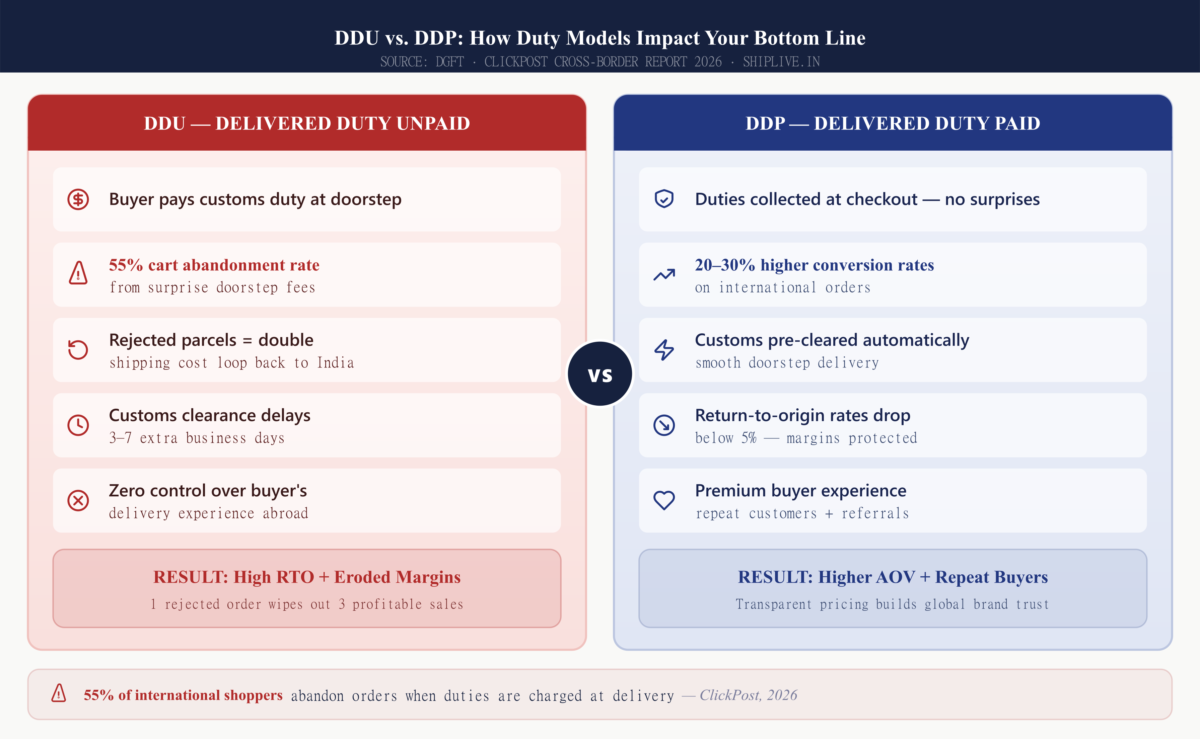
Under DDU, you ship the goods without pre-paying import taxes. The package arrives at the destination country’s customs facility. The buyer receives a call or email: pay this tax before we release your parcel.
The buyer did not budget for this. They feel cheated. They reject the delivery. The package returns to India. You pay the return freight. You pay import duty on your own returned goods. You pay warehouse handling fees. One rejected parcel wipes out the profit from multiple successful sales.
Delivered Duty Paid (DDP) shipping collects the duties at checkout. You calculate the import tax based on the product’s HS code and the destination country’s tariff rates. The buyer sees the total landed price before they enter their card details.
No surprises. No customs delays. The courier pre-clears the package, and the buyer gets a smooth doorstep delivery. Brands that switch from DDU to DDP see conversion rates improve by 20% to 30% on international orders. Return-to-origin rates drop below 5%.
Volumetric weight surcharges account for up to 60% of unexpected international shipping cost inflations. If you are packing products in oversized boxes, you are paying for air — not product.
The Dimensional Weight Formula
International carriers do not just weigh your package. They calculate volumetric weight using the formula: Volumetric Weight (kg) = (Length × Width × Height in cm) / scale variable
Scale variable is an unique value that differs from carrier to carrier. The carrier charges you whichever is higher — actual weight or volumetric weight.
A lightweight cosmetics kit weighing 0.5 kg packed in a 40cm × 30cm × 25cm box has a volumetric weight of 6 kg. You pay for 6 kg. That is 12 times the actual product weight.
Box Optimization Saves Real Money
Audit your top 20 SKUs. Measure each product’s actual dimensions. Source packaging that fits snugly — no more than 2 cm of clearance on any side.
Use void fillers like air pillows instead of crumpled paper. Air pillows protect the product without adding unnecessary box height. For irregularly shaped items, consider custom-molded inserts. The upfront cost pays for itself within the first 50 international shipments through reduced volumetric charges.
Track your carrier invoices. If you see weight disputes — where the carrier’s recorded weight exceeds your declared weight — contest them immediately with photographic proof. Platforms with automated weight dispute portals let you upload packaging images and challenge incorrect charges directly.
D2C brands using multi-carrier shipping engines save 20% to 40% on international logistics costs compared to single-carrier accounts (DGFT, 2026). No single international courier dominates every shipping lane.
The Single-Carrier Problem
DHL Express is outstanding for premium shipments to North America and Europe. But their rates to the Middle East are 30% to 40% higher than Aramex, which owns the GCC delivery network.
FedEx is strong on the US corridor. But their economy options have slower transit times than competitors on the India-UK lane.
If you lock into a single carrier, you pay premium rates on corridors where that carrier is not competitive. You overpay on every non-optimal route.
Dynamic Routing Fixes This
Multi-carrier aggregators connect your store to 17+ carrier partners. Each order is routed dynamically — the algorithm picks the carrier offering the best combination of cost, speed, and historical delivery success for that specific pin code and destination.
A package to Dubai ships via Aramex. A high-value watch to New York ships via DHL Express. A lightweight accessory to London ships via Delhivery International at economy rates.
You access enterprise-grade shipping rates without minimum volume commitments. You manage all global shipments from one dashboard. The best aggregators also integrate directly with your Shopify or WooCommerce storefront. Orders sync automatically. Labels generate with the correct carrier details. Tracking links push to your buyer’s inbox without manual copy-pasting.
Stop overpaying on routes where your carrier is not the best fit. Route dynamically.
Failing to display total landed costs at checkout leads to a 55% cart abandonment rate on international orders (ClickPost, 2026). Buyers who see a product price of $45 but discover $18 in taxes and duties after purchase feel misled — and they do not come back.
The De Minimis Complexity
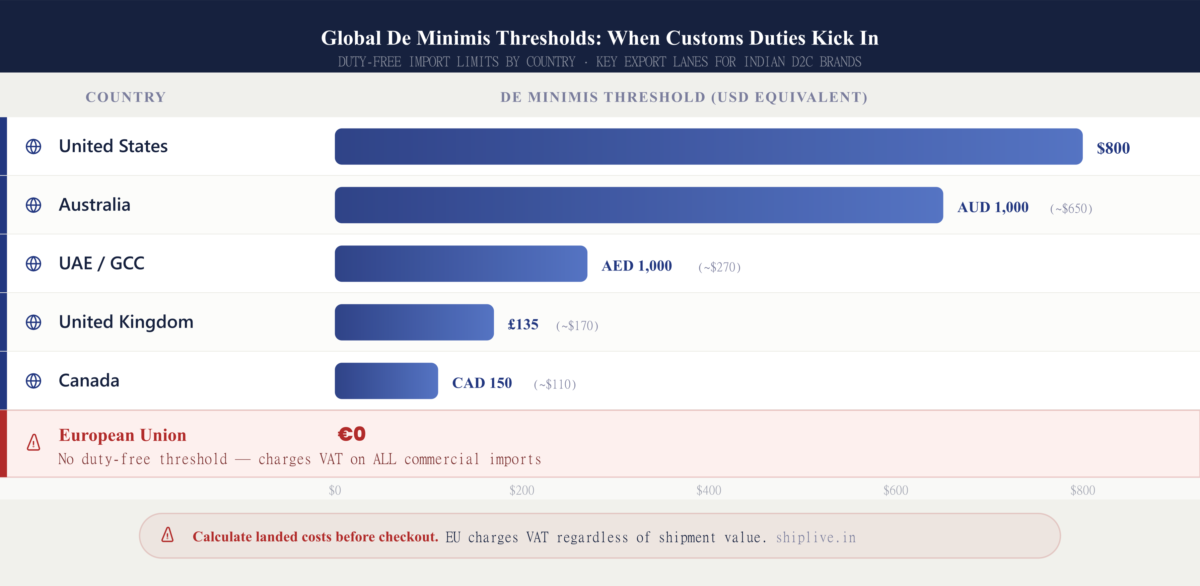
Every country sets a different de minimis threshold — the value below which imports enter duty-free.
The United States allows duty-free imports up to $800. That is generous. Most lightweight D2C products from India enter the US without any customs charge.
The European Union charges VAT on all commercial imports regardless of value. There is no duty-free threshold. A ₹500 bracelet shipped to Germany attracts 19% VAT.
The UK applies VAT to all goods but exempts customs duty below £135.
Manually calculating these thresholds for 180+ countries is impossible. Getting it wrong means your buyer either overpays at checkout (and you lose them to a competitor) or underpays (and you absorb the difference).
Real-Time Duty Calculation
Integrate a landed cost engine into your checkout flow. The engine uses the product’s HS code, declared value, and destination country’s tariff schedule to calculate the exact duties and taxes in real time.
The buyer sees the final, all-inclusive price before they pay. No surprises. No rejection at customs. No return shipping loop.
Incomplete or inaccurate commercial invoices cause over 30% of international shipment delays at customs checkpoints. The commercial invoice is the single most scrutinized document in cross-border shipping.
What Customs Officers Actually Check
The customs officer at the destination port reads your commercial invoice line by line. They compare every field against the physical contents of the package and the declared HS code.
If the product description says “accessories” instead of “925 sterling silver pendant necklace, 14g, Indian origin,” the officer flags it. Vague descriptions trigger manual inspection. Manual inspection adds 3 to 7 days. Your buyer waits. Your tracking page goes silent. Your brand reputation takes a hit before the first order even lands.
The Bulletproof Invoice Checklist
Every international commercial invoice must include:
Keep a master invoice template. Pre-populate the shipper details and IEC. Automate the product descriptions and HS codes from your product catalogue.
One missing field — a vague product description or an omitted HS code — triggers the inspection queue. The cost of a 5-day delay is not just the freight hold; it is the customer support ticket, the refund request, and the trust you lose before your brand even registers in that market.
Use a platform with channel integrations that pulls your product data directly from your store and generates compliant invoices automatically. Remove human error from the documentation process entirely.
Do I need an IEC code to ship products internationally from India?
Yes. An Import Export Code issued by the DGFT is legally mandatory for all commercial e-commerce exports from India. Customs authorities reject shipments without an active IEC linked to the shipping bill.
What is the difference between CSB-IV and CSB-V filing?
CSB-IV is for non-commercial shipments like gifts and personal parcels. CSB-V is the mandatory format for commercial courier exports under ₹10 lakh. Filing under CSB-IV for commercial sales blocks you from claiming GST refunds and RoDTEP incentives worth up to 18% of your margins.
How does DDP shipping reduce cart abandonment?
DDP collects all customs duties and taxes at checkout. The buyer sees the total landed price upfront. Over 55% of international shoppers abandon carts when unexpected fees appear at delivery. DDP eliminates that friction entirely.
How can I dispute incorrect volumetric weight charges from carriers?
Upload photographic proof of your package dimensions and actual weight immediately after shipment. Platforms with automated weight dispute portals match your declared weight against the carrier’s audit and file a contestation with evidence. Resolve disputes within 48 to 72 hours instead of weeks.
What is the US de minimis threshold for imports?
The United States permits duty-free entry for imports valued under $800 per shipment. Most lightweight D2C products from India — apparel, accessories, cosmetics — enter the US without customs charges under this threshold.





E: ecommerce@aipexworldwide.com
M: +91 90225 55616
A: 302, Twin Complex, Phase 1, Near Marol Naka Aqua Line, Andheri East, Mumbai - 400 059, Maharashtra, India.