
Every eCommerce founder knows the daily anxiety of checking the shipment dashboard. You look at the dispatch numbers. You see your sales rising. Your checkout is busy.
Then the return reports update.
A package shipped to Jaipur is coming back. A high-value order to Coimbatore is marked undelivered.
Failed deliveries are the silent profit killer of Indian eCommerce.
Logistics is no longer just a delivery function. It is a core financial strategy. If you run an online store in India, you fight a daily battle against failed deliveries and high return rates.
Important Insight
Failed deliveries cost Indian eCommerce brands up to 30% of their margins in double logistics fees. Modern multi-courier shipping platforms improve delivery success rates to over 85% by using dynamic carrier allocation, real-time address verification, and automated NDR workflows.
Let’s look at why this happens and how a multi-courier setup fixes it.
Failed deliveries account for over 23% of total shipments in the Indian eCommerce sector, directly reducing net profit margins by up to 30%. The delivery success rate is the percentage of dispatched orders that successfully reach the customer’s doorstep on the first or second attempt. A low delivery success rate means your products are stuck in a transit loop, costing you double freight fees without generating any revenue.
Payment methods have a direct impact on these numbers.
Prepaid orders have a delivery success rate of 85% to 96%. The customer has already paid. They want the product. They ensure someone is home to collect it.
Cash on Delivery (COD) is a different story. COD orders have a delivery success rate of only 65% to 75%. In Tier 2 and Tier 3 cities, it drops even lower. For a COD buyer, there is no financial barrier. They click a button, order a product, and can refuse it at the door with zero consequences – this risk falls entirely on the online seller.
Operational costs grow quickly with every failed delivery. You pay the forward shipping fee. You pay the return shipping fee. You pay for the packing material that gets destroyed when the customer tears the box open.
Your inventory remains blocked in transit for seven to ten days. During this time, you cannot sell those products to genuine buyers. Your cash is locked in trucks traveling back and forth across national highways.
Most standard shipping agents treat failed deliveries as a normal cost of business. We do not. We see failed deliveries as a failure of data. When you analyze the operational flow of a package, you see that most failures are highly preventable. If you treat logistics as a static pipeline, you lose. If you treat it as an active data network, you protect your margins.
Intelligent carrier routing engines improve first-attempt delivery success by up to 18% compared to single-carrier accounts. Dynamic courier allocation is the automated process of selecting the best carrier for every individual package based on real-time performance data. Instead of shipping every parcel with one carrier, the system evaluates cost, delivery speed, and historical performance for that specific pin code.
No single courier partner dominates every zip code in India.
If you lock your business to one courier, you suffer when their network slows down. You pay premium rates on routes where they are inefficient.
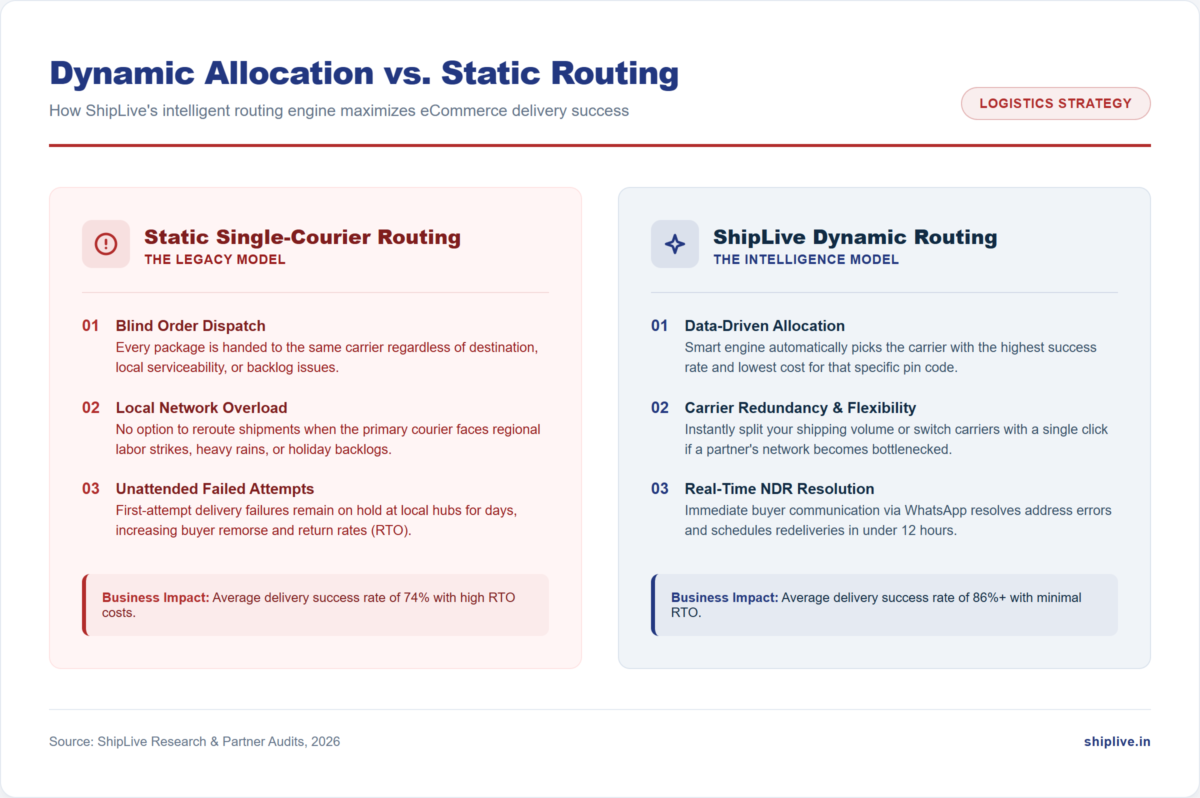
The algorithm looks at the destination pin code. It checks which carrier has the highest delivery success and offers the best rate for that specific locality and lists all the carriers for that destination pin code. Our approach matches the carrier’s strengths to the destination pin code and tracks important metrics such as transit times, delivery attempts and customer feedback..
Example: A package to Mumbai goes to Courier A because they have a 92% success rate there. A package to a village in Bihar goes to Courier B because they have the best local network.
Customer Insight
We have successfully delivered 50,000+ shipments in the last 5 years. In our analysis, we found that brands using a single courier had a delivery success rate of 74%. When they switched to a dynamic, multi-courier system, their success rate climbed to 86% within six weeks. The difference was simply matching the right carrier to the right pin code.
Exporters and domestic brands using multi-carrier platforms experience 40% fewer delays during peak holiday sales compared to single-carrier merchants according to the World Bank Logistics Performance Index (World Bank, 2023). Carrier redundancy is the practice of integrating multiple logistics networks so that your business is never dependent on a single company’s capacity. When one carrier faces a labor strike, a hub outage, or a massive backlog during festival sales, you can switch your shipments to another network.
During Diwali or New Year sales, order volumes surge.
Single-carrier networks get choked. Packages pile up in sorting hubs.
Delays grow from two days to seven days.
As transit times increase, your delivery success rate drops. Buyers get frustrated. They cancel the orders or refuse to pay on delivery.
Redundancy is your safety net.
If Courier A is facing a backlog in North India, the ShipLive Engine redirects new shipments to Courier B. Your shipping flow does not stop. This flexibility keeps your delivery times consistent.
It also gives you negotiating power. When you rely on one courier, you must accept their price hikes and service terms. When you have three other active couriers on your platform, you can negotiate better rates. You route your volume to the partners who perform well and offer fair pricing.
Technical Bottlenecks
If a courier’s API goes down, you do not have to stop your packing lines. Your shipping software switches to the backup carrier automatically. You print labels and your shipments leave on schedule. Redundancy is not just about backup options. It is about maintaining control over your operations when the wider market is in chaos.
Customer Insight
Our internal tracking of festival season logistics showed that brands with single-carrier setups saw their delivery success rates drop by 14% due to backlogs. Brands using multi-carrier platforms maintained their success rates within 2% of their yearly average by splitting their volume across three distinct courier networks.
ShipLive helps eCommerce and D2C brands improve their delivery success rates by up to 20% using the integrated RTO Shield risk engine and our automated dispute management system. As an intelligence-driven domestic shipping solution, we connect your Shopify, WooCommerce, or custom store to 17+ courier partners through a single dashboard, giving you complete control over your logistics.
Here is how the ShipLive platform secures your margins and ensures successful deliveries:
Stop shipping to high-risk buyers.
Our RTO Shield evaluates every order before you print the shipping label. It checks the buyer’s phone number against historical delivery databases.
Has this number rejected COD parcels in the past? Is the address formatted correctly? Is the pin code known for high failed delivery rates?
The system tags the order as Low, Medium, or High Risk.
You can configure the platform to automatically put high-risk orders on hold. The system then sends a WhatsApp message asking for a small prepaid deposit or address confirmation. If the buyer does not confirm, you cancel the order. You save the shipping fees both ways.
We connect you to India’s top courier networks (BlueDart, Delhivery, Shadowfax, DTDC, Ecom Express, and others).
Our smart engine routes each parcel dynamically. It selects the carrier based on live performance metrics for that specific destination. You get the best rate and the highest delivery success chance for every package.
An industry first, our platform includes a Weight Dispute Portal.
Carrier weight discrepancies can drain your profits. When a carrier claims your package was heavier than declared, our system alerts you.
You upload the packaging image and dimensions directly to the portal. We dispute the charge with the carrier on your behalf. Most disputes resolve in your favor within 48 to 72 hours, saving your margins.
This automated check stops couriers from overcharging you for “ghost weight.” You do not need to exchange endless emails with support teams. You upload the proof. The portal does the rest.
We do not hold your COD collections for weeks. Eligible merchants get their cash within 48 hours of successful delivery. This fast turnaround frees up your working capital so you can restock faster.
By reducing the payment cycle from the standard T+7 to T+2, you keep your cash moving. You can invest in marketing, buy raw materials, or pay suppliers without waiting for courier collections to clear.
No more automated email loops or chatbot frustration.
We assign a dedicated account manager to your brand. When a shipment gets stuck or a delivery agent makes a fake attempt, you talk to a real human who resolves the issue.
We built our platform to be a shield for your business – One window. Full control. Higher success rates.
What is a good delivery success rate for Indian eCommerce and D2C brands?
For eCommerce brands in India, a healthy delivery success rate is 85% or higher (Shiprocket E-commerce Index, 2025). While prepaid orders routinely achieve success rates above 90%, maintaining a high overall average requires active NDR management and automated COD verification to control failed COD deliveries.
Why do Cash on Delivery (COD) orders fail more often than prepaid ones?
COD orders fail more frequently because buyers face no immediate financial loss if they reject the package (Shadowfax India E-commerce Report, 2025). Impulsive purchases, delivery delays, and buyer’s remorse often lead COD customers to refuse delivery at the doorstep.
How does address validation improve eCommerce delivery success?
Vague or incorrect addresses account for 35% of failed first delivery attempts in India. Real-time address validation at checkout ensures that pin codes match the city and state, reducing routing errors and preventing package delays.
What is the difference between NDR and RTO in logistics?
An NDR is a temporary status when a delivery attempt fails due to customer unavailability or address issues. RTO is the final status when all delivery attempts fail, and the courier returns the package to the seller’s warehouse, incurring return shipping fees.
How does delivery speed affect the success rate of COD orders?
Every extra day a package spends in transit increases its RTO risk by 3% to 5%. Fast shipping options reduce buyer’s remorse by getting the product to the doorstep before the customer’s purchase intent fades.





E: ecommerce@aipexworldwide.com
M: +91 90225 55616
A: 302, Twin Complex, Phase 1, Near Marol Naka Aqua Line, Andheri East, Mumbai - 400 059, Maharashtra, India.