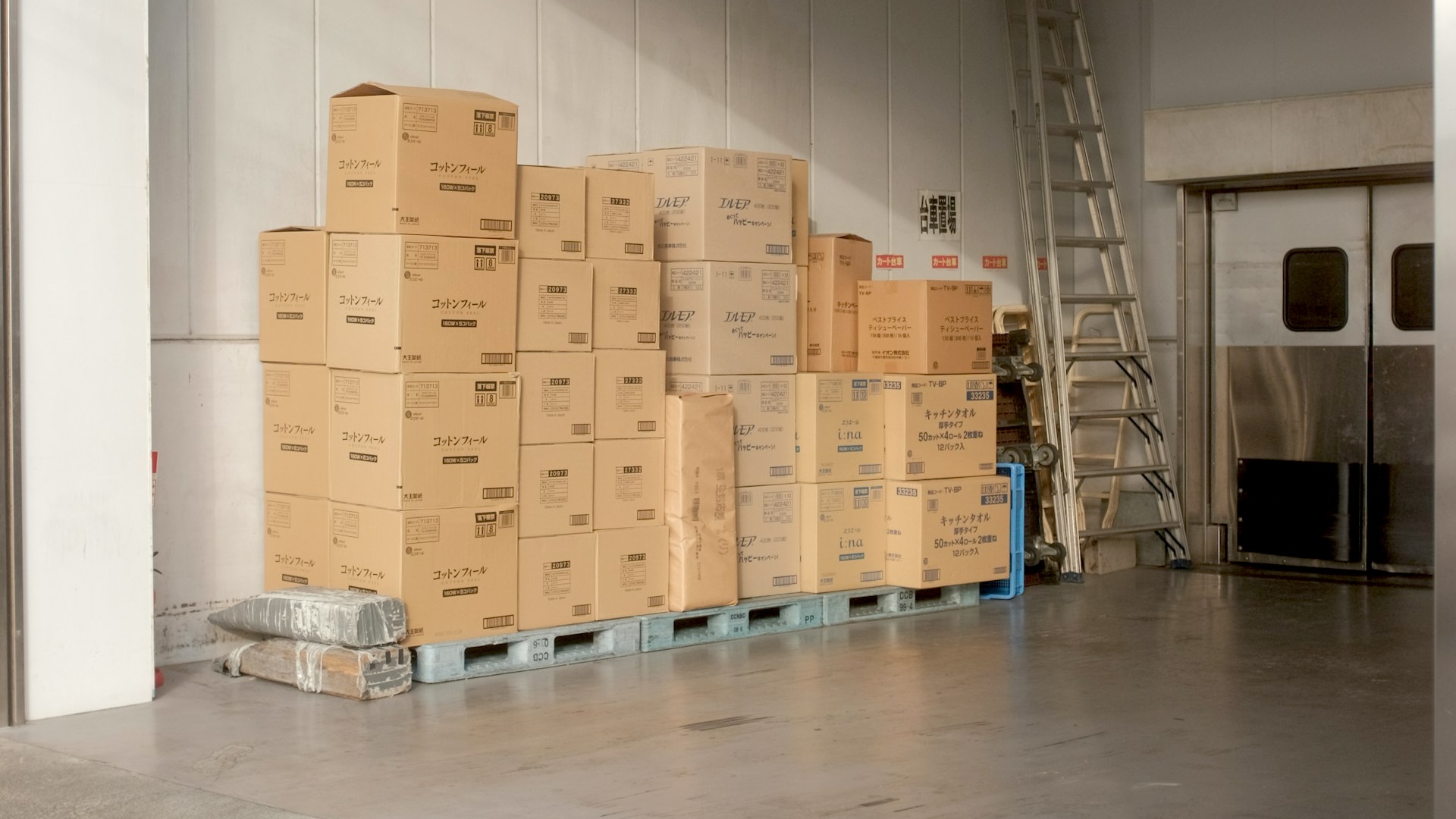

Your courier partner can make or break your eCommerce brand. That’s not an exaggeration.
A single delayed delivery costs you more than the shipping fee. It costs you a customer review, a repeat purchase, and every rupee you spent acquiring that buyer. India’s domestic eCommerce logistics market has crossed $7.25 billion in 2026 (Mordor Intelligence, 2026), and with over 19,000 deliverable pin codes, choosing the right courier partner is no longer a convenience — it’s a survival decision.
We’ve tested, compared, and shipped with nearly every major courier service operating in India. This guide breaks down the top domestic courier services for eCommerce brands in 2026 — with real stats, actual pain points, and no fluff.
TL;DR: India’s domestic courier market is growing at 10-12% CAGR with 5+ major players competing on speed, coverage, and cost. No single courier wins everywhere. Smart D2C brands use multi-carrier strategies through aggregators like ShipLive to cut shipping costs by 20-40% and reduce RTO rates below 15% (Mordor Intelligence, 2026).
COD (Cash on Delivery) still drives 50-60% of all D2C orders in India (SW Cybernetics, 2026). That means more than half your revenue depends on a delivery executive showing up, collecting cash, and completing the handoff without a hitch. Get the courier wrong, and your RTO rate climbs past 25%. Get it right, and you protect your margins on every single order.
The game has changed. Customers in Tier 2 and Tier 3 cities now expect the same 2-3 day delivery that metros get. They expect real-time tracking. They expect smooth returns. The brands that match those expectations win repeat business. The ones that don’t — they bleed money through RTOs, weight disputes, and delayed COD remittance.
Here’s what we’ve found after shipping thousands of orders: the “best” courier isn’t a single company. It’s a strategy. Different couriers dominate different geographies, price points, and product categories. Your job is to match the right courier to the right order.
And that’s exactly what this guide helps you do.
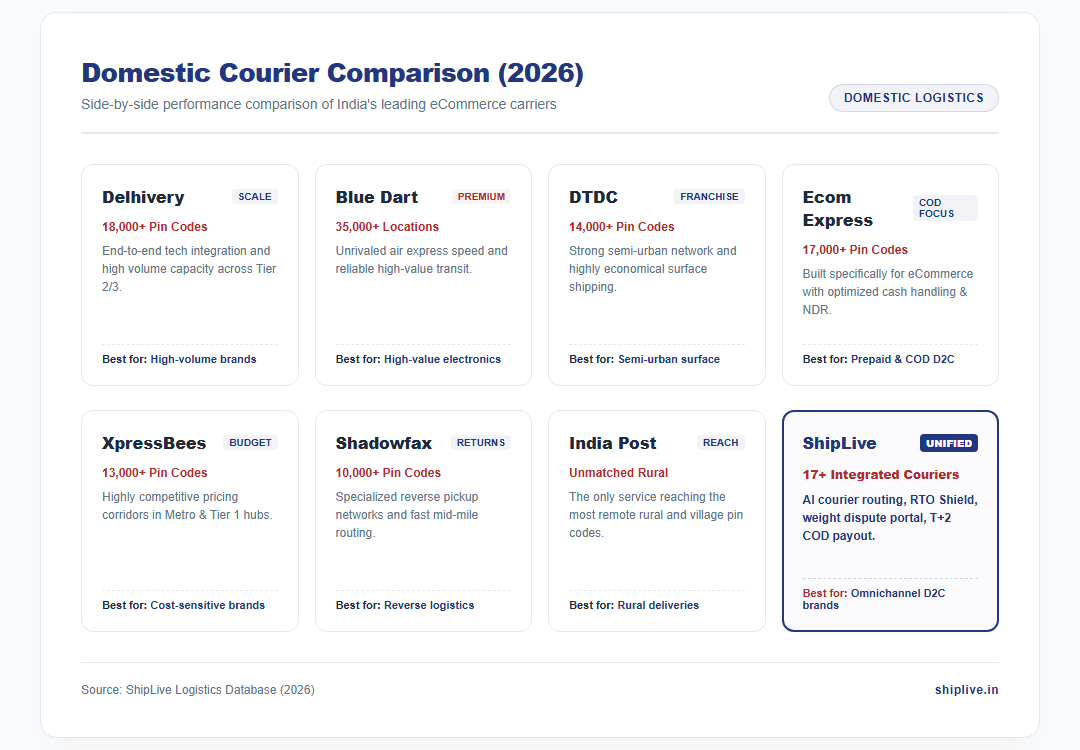
India’s domestic courier, express, and parcel (CEP) market is valued between $6.27 billion and $10.58 billion in 2026, growing at a steady 10-12% CAGR (Mordor Intelligence, 2026). The competition is fierce, and each player brings a different strength to the table. Here’s how the top domestic courier services stack up for eCommerce brands this year.
Delhivery handles the highest shipment volume among private courier companies in India. Their network covers 18,000+ pin codes, and their tech stack is built ground-up for eCommerce fulfillment.
Best for: Pan-India scale, heavy-volume brands, Tier 2/3 reach
Strength: End-to-end technology integration, massive pin code coverage, warehousing services
Watch out for: Premium pricing on express services, variable last-mile performance in remote areas
Blue Dart has been India’s premium courier for decades. If you ship high-value products — electronics, jewelry, luxury goods — Blue Dart’s reliability is hard to match. Their air express network delivers across 35,000+ locations.
Best for: High-value shipments, time-sensitive deliveries, metro-to-metro express
Strength: Exceptional speed, strong brand trust, superior handling for fragile items
Watch out for: Higher per-shipment cost, limited cost advantage for budget-conscious brands
DTDC brings deep roots in semi-urban and Tier 2/3 India. With 10,000+ franchise partners and 14,000+ pin code reach, they’ve built ground-level distribution that most newer players can’t replicate overnight.
Best for: Tier 2/3 city deliveries, franchise-level reach, economical shipping
Strength: Strong semi-urban network, cost-effective for surface shipments, extensive franchise coverage
Watch out for: Inconsistent delivery timelines in some zones, technology platform catching up
Built exclusively for eCommerce, Ecom Express doesn’t handle B2B or traditional courier packages. That singular focus means their operations, technology, and workforce are all optimized for online order fulfillment.
Best for: Pure-play eCommerce brands, COD-heavy businesses, reverse logistics
Strength: eCommerce-first operations, strong COD management, automated NDR handling
Watch out for: Narrower service portfolio, less flexible for non-eCommerce shipments
XpressBees grew from a logistics arm of FirstCry into one of India’s most aggressive courier companies. They’re strong in Tier 1 and Tier 2 cities, with competitive pricing that appeals to cost-conscious D2C brands.
Best for: Cost-sensitive brands, Tier 1/2 city coverage, growing D2C businesses
Strength: Competitive pricing, tech-driven operations, strong investor backing for rapid scaling
Watch out for: Still building deep Tier 3 coverage, variable performance outside key corridors
Shadowfax specializes in mid-mile logistics and reverse shipping. If your brand deals with high return volumes — fashion, apparel, footwear — Shadowfax’s reverse logistics capabilities stand out.
Best for: Reverse logistics, mid-mile distribution, brands with high return rates
Strength: Strong returns management, hyperlocal delivery capability, scalable operations
Watch out for: Forward delivery network less dense compared to Delhivery or Blue Dart
Don’t ignore India Post. With the deepest pin code penetration in the country — reaching villages that no private courier touches — India Post is the only option for truly rural deliveries. Their Speed Post service has improved significantly.
Best for: Rural and remote area deliveries, maximum pin code coverage, budget shipping
Strength: Unmatched geographical reach, government-backed infrastructure, lowest cost option
Watch out for: Longer delivery timelines, limited real-time tracking, inconsistent handling quality
ShipLive takes a different approach. Instead of being a single courier, ShipLive is an intelligence-driven shipping aggregator that connects your store with 17+ carrier partners — including Delhivery, Blue Dart, DTDC, Shadowfax, and more — through one unified domestic shipping dashboard.
Best for: D2C brands wanting multi-carrier flexibility, RTO reduction, transparent billing
Strength: AI-powered courier selection across 19,000+ pin codes, T+2 COD remittance, Weight Dispute Portal, dedicated account managers with zero-bot support policy, RTO Shield for high-risk order flagging
Watch out for: Best suited for brands ready to scale; very small volumes may not unlock full feature benefits
ShipLive in essence is a shipping aggregator platform.
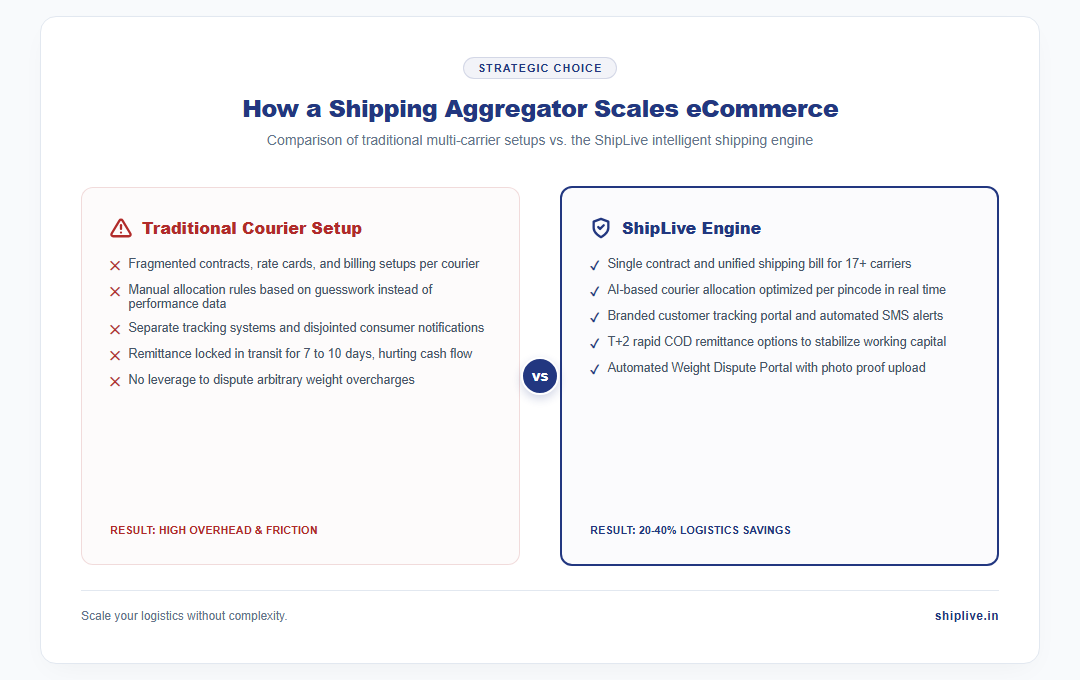
In our experience, the biggest headache for D2C brands isn’t choosing a courier — it’s managing multiple couriers simultaneously. ShipLive’s platform auto-selects the best carrier for each pin code and order type. You ship one order with Delhivery to Jaipur and the next with Blue Dart to Mumbai — all from the same dashboard, with one invoice.
Shipping aggregators have reduced per-shipment costs by 20-40% for D2C brands using multi-carrier strategies (Shipmozo, 2026). The aggregator model has fundamentally changed how eCommerce brands think about logistics in India.
Here’s the reality: no single courier excels everywhere. Delhivery’s rates are unbeatable for heavy parcels going to Tier 2 cities. Blue Dart’s speed is unmatched for metro express. Ecom Express handles COD better than most. But managing separate contracts, dashboards, tracking pages, and invoices with each carrier? That’s an operational nightmare for a 10-person D2C brand.
Shipping aggregators like ShipLive solve this by giving you one dashboard, one API, one invoice — and the freedom to ship with whichever carrier performs best for each order. You get the rate advantages of volume across all carriers combined, not just one.
Our platform features include
These aren’t nice-to-have features. They directly protect your margins. Smart D2C founders aren’t asking “which courier should I use?” anymore. They’re asking “which aggregator gives me access to the best couriers with the least friction?”
India’s CEP market is expected to grow at 17%+ CAGR through 2033 (Grand View Research, 2026). With more courier options entering the market every year, you need a structured way to compare. Here’s the evaluation framework we use.
What to check: Total serviceable pin codes, Tier 2/3 depth
Why it matters: 60%+ of D2C growth comes from non-metro cities
What to check: What’s the average delivery timelines for tier 1, 2 or 3 cities.
Why it matters: Faster delivery = lower RTO, higher NPS
What to check: Remittance cycle (T+2 vs T+7), cash reconciliation
Why it matters: Cash flow directly impacts working capital
What to check: NDR automation, risk scoring, buyer verification
Why it matters: RTO can directly impact your revenue an in some cases costs ₹150-400 per failed order
What to check: Turn around time for return pickups, refund processing
Why it matters: On average in India 15-20% of eCommerce orders get returned
What to check: API quality, tracking page, dashboard UX and channel integrations
Why it matters: It determines the performance, ease of use and the best fit for your e-commerce brand
What to check: Are you getting a dedicated manager or standard chat based ticket queue, escalation path
Why it matters: Shipping related support is one of the most critical aspect especially during peak sale seasons
What to check: Per-shipment cost by weight slab and zone
Why it matters: Getting the best rates per weight and zone is the most important aspect that directly impacts your revenue
Don’t make the common mistake of choosing purely on price. The cheapest courier that consistently fails deliveries in your top-selling pin codes will cost you far more in lost customers than a slightly pricier option with reliable performance.
Which courier service is best for small eCommerce businesses in India?
For small eCommerce businesses shipping fewer than 500 orders per month, a shipping aggregator like ShipLive gives you access to negotiated rates across 17+ carriers without volume commitments. The India domestic CEP market is valued at $6.27 billion in 2026 (Mordor Intelligence, 2026), meaning competition keeps prices accessible even for smaller brands.
How do I reduce shipping costs for my D2C brand?
Use a multi-carrier approach through an aggregator. Brands using platforms like ShipLive’s domestic shipping have cut shipping costs by 20-40% by auto-comparing rates across carriers for each order. Negotiate volume-based rates, use surface shipping for non-urgent orders, and consolidate shipments where possible.
What is a good RTO rate for eCommerce in India?
The national average RTO rate for D2C brands sits between 20-30% (ClickPost, 2026). A “good” RTO rate is below 15%. Top-performing brands using automated NDR workflows and buyer verification maintain RTO rates of 8-12%. Focus on prepaid conversion and proactive order confirmation to get there.
Is COD still relevant in Indian for online shopping?
COD accounts for 50-60% of all D2C orders in India, even in 2026 (SW Cybernetics, 2026). While digital payments are growing, COD remains essential for building trust with first-time buyers in Tier 2/3 cities. The goal isn’t to eliminate COD — it’s to manage it profitably with fast remittance cycles and smart RTO prevention.
How does a shipping aggregator differ from a courier company?
A courier company operates its own fleet and delivery network.
A shipping aggregator like ShipLive connects you with multiple courier companies through one platform, letting you compare rates, auto-select the best carrier per order, and manage all shipments from a single dashboard. India’s eCommerce logistics market at $7.25 billion in 2026 (Mordor Intelligence, 2026) is increasingly driven by aggregators enabling multi-carrier strategies.






E: ecommerce@aipexworldwide.com
M: +91 90225 55616
A: 302, Twin Complex, Phase 1, Near Marol Naka Aqua Line, Andheri East, Mumbai - 400 059, Maharashtra, India.